Global Energy Outlook 2025: Record Clean Energy Investment Meets Record Emissions – What It Means for the Transition
The 2025 Global Energy Outlook harmonizes 13 scenarios to reveal a stark paradox: clean energy investment hit $2 trillion in 2024, yet global CO₂ emissions also reached an all-time high. While wind and solar are projected to supply over 50% of electricity by 2050 in every scenario, coal’s decline varies dramatically, and natural gas remains a wildcard. China dominates solar capacity growth, accounting for 60% of global additions in 2023, while the rest of the world lags with growth rates of 6.7–12% CAGR. This article unpacks the economic logic behind these trends, the geopolitical dependencies shaping supply chains, and the policy uncertainties—especially pre-U.S. election assumptions—that could derail or accelerate the energy transition.
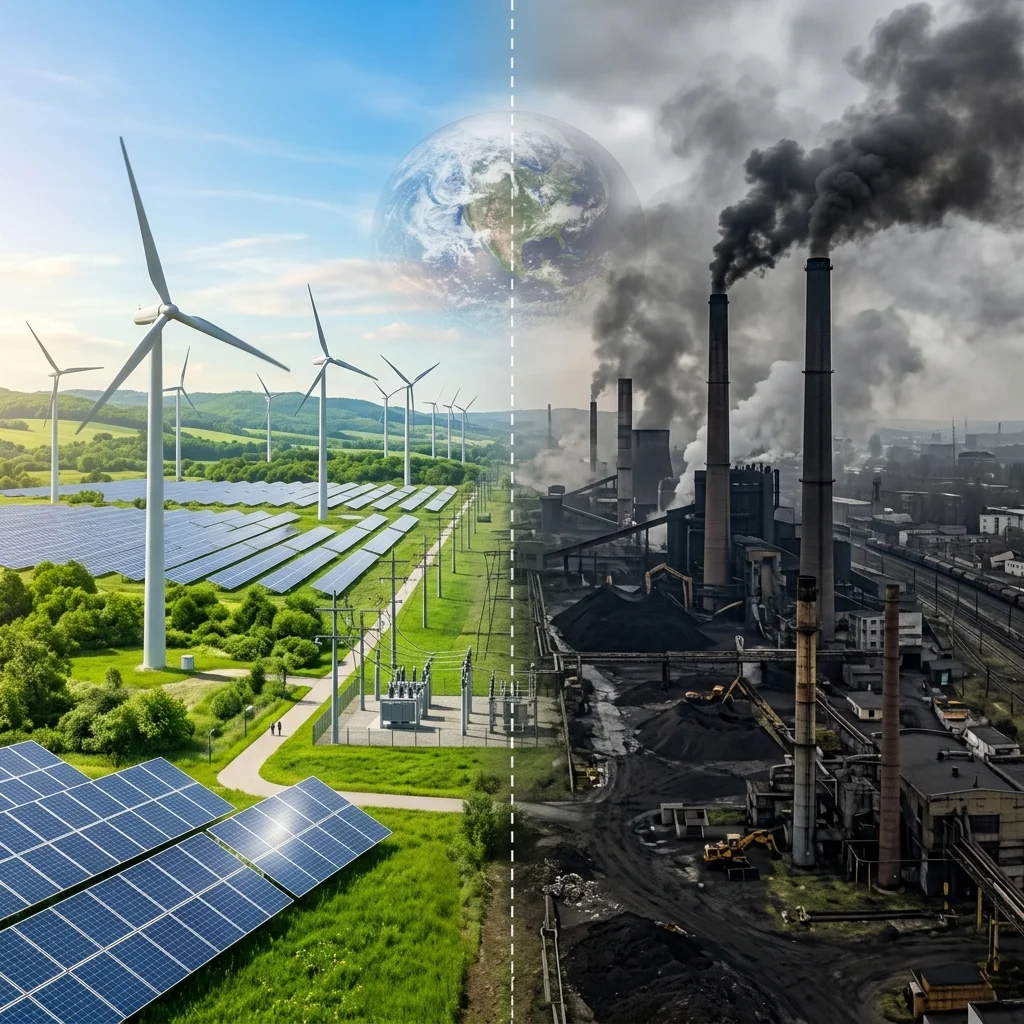
Global Energy Outlook 2025: Record Clean Energy Investment Meets Record Emissions – What It Means for the Transition
In 2024, the world poured an unprecedented $2 trillion into clean energy technologies and infrastructure. Solar farms, wind turbines, battery factories, and electric vehicle charging networks expanded at breakneck speed. Yet at the same moment, global carbon dioxide emissions from energy and industry also reached an all-time high. This stark paradox—record spending on decarbonization alongside record pollution—defines the central tension in the 2025 Global Energy Outlook, a comprehensive synthesis of 13 long-term energy scenarios published by Resources for the Future (RFF).
The report harmonizes projections from leading institutions including the International Energy Agency (IEA), BP, BloombergNEF (BNEF), the Japan Institute of Energy Economics (IEEJ), and other major forecasters. The result is a sobering but nuanced picture: while wind and solar are on track to dominate electricity generation by 2050, the pace and geography of the energy transition remain deeply uneven, and the future of coal and natural gas hangs in the balance. This article unpacks the economic logic, geopolitical dependencies, and policy uncertainties that will shape the next quarter-century of global energy.
---
The Investment-Emissions Paradox: Record Spending, Record Pollution
The headline numbers capture the contradiction. According to RFF’s analysis, **clean energy investment reached approximately $2 trillion in 2024**, a figure that includes spending on renewable power generation, grid modernization, energy storage, electric vehicles, and hydrogen infrastructure. Adjusted for inflation, this represents a more than 60% increase from 2020 levels. Yet global energy-related CO₂ emissions also hit a new peak, driven by continued reliance on coal in Asia and rising natural gas consumption in industrializing economies.
This paradox reveals a core economic logic: despite unprecedented capital flows, the inertia of existing coal, oil, and gas assets continues to drive emissions, while the clean energy build-out is still playing catch-up in absolute terms. RFF’s annual Global Energy Outlook harmonizes a range of long-term energy projections to find key trends. As the report notes, “Even in scenarios with aggressive climate policies, the stock of existing fossil-fuel infrastructure ensures that emissions remain elevated for at least another decade before beginning a sustained decline.”
[IMAGE: A side-by-side bar chart comparing annual clean energy investment (in trillions of USD) against global CO₂ emissions (in gigatons) from 2020 to 2024, using data from the RFF report. The left axis shows investment rising steeply, while the right axis shows emissions plateauing near record highs.]
Table 1 in the RFF report demonstrates that across all 13 scenarios, global primary energy demand continues to grow through 2030 before diverging sharply. In the most ambitious decarbonization pathways—such as the IEA’s Net Zero Emissions (NZE) scenario—emissions peak before 2025 and fall 50% by 2040. In the least ambitious scenarios, such as IEEJ’s Reference case, emissions remain near current levels through 2050. The gap between these trajectories represents the difference between a transformed energy system and a prolonged fossil-fuel lock-in.
---
Solar and Wind Take the Lead – But China Holds the Cards
One of the most robust findings of the 2025 Outlook is the near-universal dominance of solar and wind in future electricity generation. Under **all 13 scenarios**, wind and solar combined provide more than 50% of global electricity by 2050. Solar and wind alone account for **37% to 74%** of generation in that year—a remarkable bandwidth that reflects each scenario’s assumptions about policy support, technology costs, and grid integration.
This convergence is driven by economics. The levelized cost of solar photovoltaic (PV) electricity has fallen by roughly 90% over the past decade, making it the cheapest source of new electricity in most of the world. Wind power, both onshore and offshore, has seen similar cost reductions. As a result, even in scenarios with no new climate policies, renewable energy continues to expand because it outcompetes fossil fuels on price.
Yet the global distribution of this capacity is deeply lopsided. **China dominates** solar deployment: it drove more than 60% of global solar capacity additions in 2023, and together with the United States and Europe, these three regions hold approximately 75% of total installed solar capacity. This concentration poses significant supply-chain and geopolitical risks for the rest of the world. China controls the vast majority of solar manufacturing—from polysilicon to modules—meaning that any trade disruption or geopolitical tension could slow deployment in other regions.
[IMAGE: A world map with country-level color coding showing solar capacity growth rates from 2023 to projected 2050. A call-out box highlights China’s 60% share of global solar additions in 2023 and notes that the U.S., Europe, and China together account for 75% of total installed solar capacity.]
The divergence between regions is most apparent in the rest-of-world (ROW) solar growth projections. The compound annual growth rate (CAGR) for solar capacity outside of China, the U.S., and Europe ranges from **6.7% (IEEJ Reference) to 12% (IEA APS and bp NZE)** from 2023 to 2050. This means that in the slower-growth scenario, developing nations—many with high solar potential and rapidly rising electricity demand—will only see modest capacity increases, potentially locking them into fossil-fuel dependence for decades. Whether this gap narrows depends on international finance, technology transfer, and domestic policy reforms.
---
Coal’s Uncertain Sunset and Natural Gas’s Wild Future
If solar and wind are the headline stars of the energy transition, coal and natural gas are the wildcards. The RFF report reveals an extraordinary range in projected coal consumption across scenarios, reflecting fundamental disagreements about how quickly the world’s most carbon-intensive fuel can be phased out.
**Coal electricity generation declines by 35% (IEEJ Reference) to 94% (bp NZE, IEA NZE) from 2023 to 2050.** This massive spread—from a partial reduction to near-total elimination—illustrates that without aggressive policy intervention, coal remains economically viable in many regions, particularly in China and India where existing coal fleets are relatively young. In the IEEJ Reference scenario, coal still supplies nearly 25% of global electricity in 2050, driven by industrial demand and grid reliability concerns. In the IEA NZE scenario, coal generation essentially disappears by 2040, replaced by renewables, nuclear, and carbon capture.
**Natural gas projections vary even more wildly:** from a **7% decline (BNEF ETS) to an 83% increase (IEEJ Reference)** over the same period. This uncertainty carries profound implications for investors and policymakers. Natural gas has often been promoted as a “bridge fuel” that can displace coal while renewables scale up. But in several scenarios—particularly those with strong climate policies—gas demand peaks within the next decade and then declines sharply. In the BNEF ETS scenario, for example, gas generation falls as variable renewables and battery storage render gas-fired power plants uneconomic.
The risk of stranded assets is real. Liquefied natural gas (LNG) terminals, gas pipelines, and combined-cycle gas turbines built today have lifetimes of 30–50 years. Depending on which scenario unfolds, a significant portion of this infrastructure could become obsolete long before its economic life ends. The report notes that “natural gas projections are the most sensitive to policy assumptions, making it the most unpredictable major fuel in the energy transition.”
[IMAGE: A grouped bar chart showing 2023–2050 change in coal and natural gas electricity generation for four representative scenarios (IEEJ Reference, IEA STEPS, IEA NZE, BNEF ETS). The chart highlights the wide range, with bars showing percentage change from a baseline.]
| Scenario | Coal Change 2023–2050 | Natural Gas Change 2023–2050 | |----------|----------------------|------------------------------| | IEEJ Reference | –35% | +83% | | IEA STEPS | –55% | +15% | | BNEF ETS | –80% | –7% | | IEA NZE / bp NZE | –94% | –65% |
*Table: Selected scenario projections for coal and natural gas generation, adapted from RFF Global Energy Outlook 2025.*
---
Policy Uncertainty and the Pre‑Election Wildcard
The wide scenario ranges are not merely academic exercises. They reflect genuine uncertainty about the political will to enact and sustain climate policies. The 2025 Global Energy Outlook was developed before key global elections—including the U.S. presidential election—meaning that the scenarios do not fully account for potential policy reversals or new ambitious targets.
In the United States, the Inflation Reduction Act (IRA) has already spurred a surge in clean energy investment, but its long-term impact depends on future congressional action and executive enforcement. A shift toward fossil-fuel-friendly policies could slow the domestic transition and reduce U.S. influence in global climate negotiations. Similarly, the European Union’s Green Deal faces headwinds from energy security concerns and industrial competitiveness pressures.
China’s trajectory is perhaps the most critical variable. As the world’s largest emitter and the dominant force in solar manufacturing, Beijing’s policy choices will shape global emissions for decades. The 2025 Outlook shows that even in China’s most ambitious scenarios, coal use declines slowly due to its role in industrial heat and power system stability. However, China’s rapid build-out of wind, solar, and nuclear means that its emissions could peak before 2030 even under moderate policies.
---
What It Means for the Energy Transition
The 2025 Global Energy Outlook delivers a clear but uncomfortable message: the energy transition is real, but it is not happening fast enough or evenly enough to meet global climate goals. Record clean energy investment is a testament to the economic viability of renewables, but record emissions demonstrate that deployment is still too slow to offset the growth in fossil-fuel consumption.
The path forward requires three simultaneous actions:
1. **Accelerate the clean energy build-out in the rest of the world.** Without international financing and technology transfer, developing nations will remain locked into fossil fuels. The divergence in solar CAGR between regions must be addressed through multilateral climate funds, reduced trade barriers, and grid modernization.
2. **Prepare for natural gas uncertainty.** Investors and policymakers should avoid locking into long-term gas infrastructure that may become stranded. Flexible, short-term contracts and dual-fuel capabilities can hedge against diverse future scenarios.
3. **Phase out coal deliberately but decisively.** The wide range of coal decline scenarios is not inevitable. Targeted policies—such as carbon pricing, coal retirement mandates, and just transition programs—can shift the trajectory toward the more ambitious end of the spectrum.
The energy transition is not a single story. It is a collection of regional, technological, and political narratives that are still being written. The 2025 Global Energy Outlook provides the data and scenarios to inform these decisions. The choice of which scenario becomes reality now rests with governments, investors, and citizens alike.