Global Electricity Review 2026: Solar and Storage End Fossil Growth, Rewriting the Energy Playbook
The 2026 Global Electricity Review reveals a structural turning point: clean power met all 849 TWh of new electricity demand, pushing fossil generation into decline (-0.2%). Solar alone provided 75% of demand growth, and with battery storage costs plummeting 45% and deployment surging 46%, renewables overtook coal in the global generation mix (33.8%). China and India both saw fossil output fall for the first time, while Chile and Australia proved that grid-level storage can shift over half of new solar generation. This is not a temporary blip but a market-driven realignment—behind the headlines lie deep implications for fossil asset valuations, supply chains for solar and batteries, and utility business models worldwide.
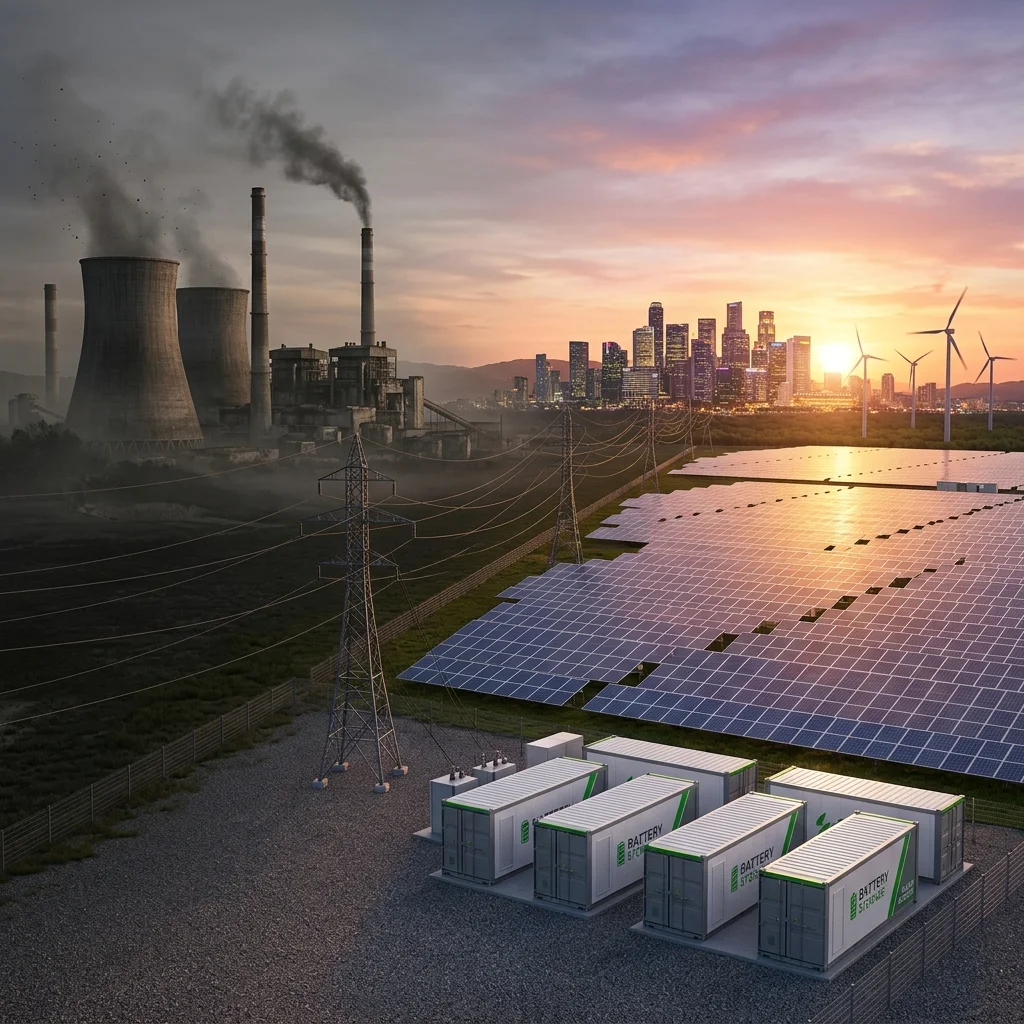
Global Electricity Review 2026: Solar and Storage End Fossil Growth, Rewriting the Energy Playbook
The Moment Fossil Generation Stopped Growing: A Structural Shift, Not a Cyclical Blip
In 2025, global electricity demand rose by 849 terawatt-hours (TWh) — equivalent to adding an economy the size of Japan to the world's power grid. Yet for the first time in history, total fossil fuel generation actually fell, dropping by 0.2%. This single data point, published in the *Global Electricity Review 2026* by energy think tank Ember, signals something far more consequential than a temporary pause.
The conventional narrative held that clean energy could only displace fossil fuels during recessions or demand slumps. That logic no longer applies. Demand grew robustly, but every single unit of new electricity was supplied by low-carbon sources. Renewables — led by solar and wind, with a crucial assist from battery storage — added 887 TWh of generation, pushing their global share to 33.8%. That milestone marks the first time renewables have overtaken coal in the global generation mix. Coal's share fell below 30% for the first time, while gas generation remained flat.
[IMAGE: A line chart overlay showing global electricity demand growth vs. fossil generation change year-on-year, with a clear divergence in 2025.]
This is not a cyclical downturn. The International Energy Agency had forecast that fossil generation would plateau around 2025, but the actual decline arrived earlier and faster than most models predicted. The implications for fossil asset valuations are stark. Coal plants that are still within their financial depreciation schedules are now facing revenue erosion from cheap solar-plus-storage alternatives. Utilities and investors must reassess risk profiles that were built on assumptions of continued demand growth for fossil power. The old playbook — building new gas plants to meet peak demand — is being rewritten by a combination of solar supply and agile battery dispatch.
Behind the headline numbers lies a deeper structural reality: the cost of inaction on storage and grid flexibility is now higher than the cost of action. Countries that failed to invest in grid-level storage saw higher levels of curtailment and slower declines in fossil generation. Those that did, like Chile and Australia, proved that the clean transition is not only possible but economically superior.
Solar’s 75% Share of Demand Growth: The Dominant Force in Power Markets
Solar power alone contributed 75% of the world's 849 TWh of new electricity demand in 2025. To put that in perspective, global solar generation last year was roughly equal to the entire electricity consumption of the European Union — approximately 2,800 TWh. This is not a niche technology any longer; solar is now the single largest source of new power on the planet.
China once again dominated additions, installing more than half of the world's new solar capacity. Its cumulative solar fleet is now approaching 1,000 GW, and its clean energy generation growth outpaced total electricity demand growth for the first time, forcing coal generation down by 1.7%. But the more striking story came from India. In 2025, India doubled its previous annual record for renewable capacity additions, installing over 40 GW of solar — surpassing the United States for the first time. India’s renewable record-breaking year pushed its fossil generation into decline for the first time in recorded history, a watershed moment for the world’s fastest-growing major economy.
[IMAGE: World map heatmap showing solar generation growth per country in 2025, with China and India glowing brightest.]
The economics behind this shift are relentless. Solar module prices have collapsed by more than 60% since 2023, driven by massive manufacturing overcapacity in China. In most regions, the levelized cost of solar-plus-storage is now cheaper than new coal or gas-fired generation, even without subsidies. The bottleneck, however, is no longer solar panel availability — it is grid integration. Solar’s intermittency is now the critical constraint, and countries that invest aggressively in transmission, smart grids, and battery storage are the ones that see the highest solar utilization rates and the fastest fossil fuel displacement.
The solar growth story is also reshaping global supply chains. While module manufacturing remains heavily concentrated in China, inverter and tracker manufacturing is diversifying to Southeast Asia and India. Battery cell production is expanding rapidly in Europe and North America, driven by policy incentives and corporate commitments to supply chain resilience. The next wave of solar deployment will depend not on panel costs but on balance-of-system costs — permitting, labor, grid connection infrastructure — which are increasingly the largest share of total project costs.
Deep insight: the countries that treat solar and storage as a single, integrated system — not separate technologies — are the ones rewriting the energy playbook. The historical pattern of "build solar first, worry about storage later" is being replaced by a bundled deployment model, where every new large-scale solar farm is designed from the start with co-located or contracted battery capacity.
Battery Storage: The Silent Partner That Made 2025 Possible
Without the extraordinary growth of battery storage, the 2025 landmark would have been impossible. Global battery storage deployment reached 250 gigawatt-hours (GWh) of energy capacity in 2025 — a 46% year-on-year increase. At the same time, battery pack costs fell 45% in two years, from an average of $139/kWh in 2023 to below $80/kWh by the end of 2025. This collapse in cost is the structural lever that turned solar from a daytime-only resource into a dispatchable power source capable of meeting evening peaks and overnight demand.
[IMAGE: Bar chart showing global battery storage annual additions in GWh from 2020 to 2025, with a sharp upward trend and annotated cost decline line.]
Two countries demonstrated the concept better than anyone: Chile and Australia. In both markets, grid-level storage shifted more than 50% of new solar generation from daytime hours to evening and morning slots, dramatically reducing solar curtailment. Chile's Atacama Desert solar farms, which previously faced curtailment rates as high as 20% during peak solar hours, saw curtailment drop below 5% after the commissioning of large battery arrays. Australia's National Electricity Market, which already has one of the world's highest solar penetrations, relied on a fleet of utility-scale batteries to absorb midday solar output and discharge it during the evening demand ramp, enabling the country to run on over 70% renewable electricity for several hours on multiple occasions.
The implications for grid stability are profound. Historically, system operators worried that high solar penetration would destabilize grids because of rapid fluctuations. Batteries provide sub-second response times that can mimic or exceed the inertia provided by conventional thermal plants. In 2025, battery storage became not just an economic enabler but a grid reliability tool. Markets that implemented fast frequency response auctions and capacity mechanisms for storage saw lower operational costs and fewer curtailment events.
Cost declines are not over. The 45% drop in battery costs since 2024 is expected to continue as sodium-ion chemistries begin commercial scale-up and lithium-iron-phosphate (LFP) production lines achieve economies of scale beyond current levels. BloombergNEF predicts that battery packs could reach $50/kWh by 2028, making solar-plus-storage cost-competitive with even existing coal and gas plants in almost every market. This trajectory underpins the *Global Electricity Review 2026*’s central conclusion: the era of fossil growth in electricity is over, and the replacement is market-driven, not policy-dependent.
For utility business models, the storage revolution forces a hard reckoning. The old revenue model — selling bulk electricity from baseload plants — is being disrupted by a distributed, time-varying, and storage-enabled system. Utilities that embrace storage as a core asset will thrive; those that cling to fossil legacy plants face accelerating revenue erosion. The battery storage deployment surge of 250 GWh in 2025 is not a peak but a floor. Every subsequent year is expected to set a new record, as manufacturing capacity expands and project pipelines swell.
The conclusion from the *Global Electricity Review 2026* is unambiguous: the global power sector has reached a structural turning point. Solar and storage have not only ended fossil growth — they have rewritten the rules of the energy playbook. The question for policymakers, investors, and utilities is no longer whether the transition will happen, but how fast they can adapt to the new reality.