BloombergNEF New Energy Outlook 2026: How Clean Power and Electrification Reshape Global Energy Security by 2050
BloombergNEF’s New Energy Outlook 2026, published on May 19, 2026, unveils a new base-case scenario and a major update to its well-below-2°C pathway. Analyzing energy, electricity, transport, buildings, and industry through 2050, the report reveals that countries reliant on imported fossil fuels can dramatically improve energy security by scaling clean power and electrification. The Economic Transition Scenario shows emissions entering structural decline driven by renewables and EVs, while the Net Zero Scenario adds hydrogen, carbon capture, and sustainable fuels for deeper decarbonization. With detailed import-dependence projections for 2025, 2035, and 2050, and a hypothetical ''no transition'' counterfactual, this analysis underscores the converging logic of climate action and geopolitical resilience. Key findings: clean power and electrification deliver the majority of near-term emissions cuts, and strong technology fundamentals underpin growth in solar, batteries, and EVs.
BloombergNEF New Energy Outlook 2026: How Clean Power and Electrification Reshape Global Energy Security by 2050
Introduction: A New Lens on the Energy Transition
On May 19, 2026, BloombergNEF released its flagship New Energy Outlook 2026, introducing a new base-case scenario—the **Economic Transition Scenario (ETS)**—alongside a major update to its well-below-2°C **Net Zero Scenario (NZS)**. Covering electricity, industry, buildings, and transport through 2050, the report places a specific focus on **energy security**, a topic that has "risen to the top of the policy agenda" according to the authors.
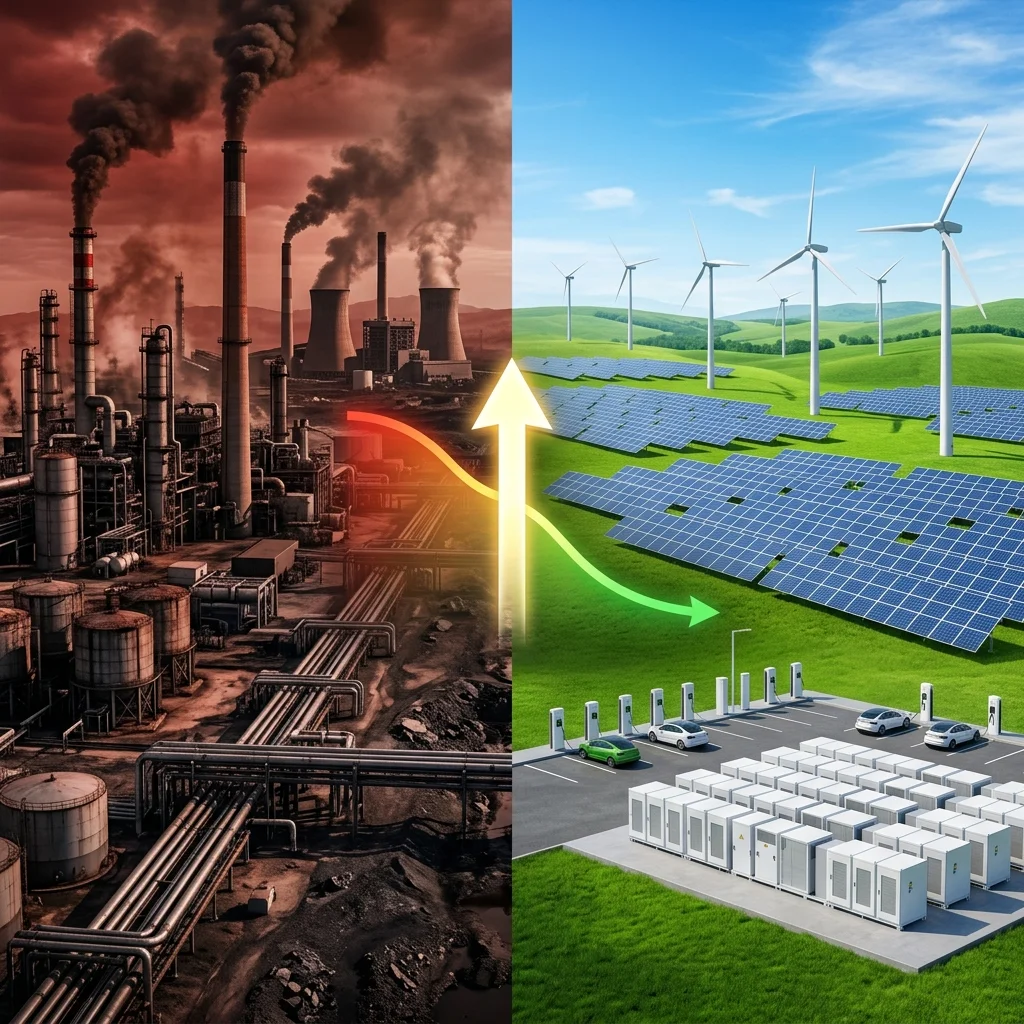
For the first time, BloombergNEF uses a hypothetical "no transition" scenario as a counterfactual, fixing clean-tech costs at 2026 levels and capping deployment. This thought experiment reveals the true cost of inaction, underscoring how the economic logic of **decarbonization** now aligns with **energy independence**. By scaling **clean power** and **electrification**, countries can dramatically reduce their vulnerability to fossil-fuel price shocks and reshape the global energy trade map by 2050.
[IMAGE: World map highlighting regions with high fossil fuel import dependence (Europe, East Asia) overlaid with renewable energy icons (wind, solar) and arrows showing declining import reliance by 2050.]
The Two Scenarios: Structural Decline vs. Accelerated Decarbonization
The **Economic Transition Scenario (ETS)** models a world where emissions enter a structural decline driven primarily by market forces: **renewables** displacing coal in power generation, and **EVs** slowing oil demand. No additional climate policies beyond current market trends and cost declines are assumed. This scenario demonstrates that even without aggressive government intervention, the momentum of **solar**, **batteries**, and **EVs** pushes global emissions onto a downward trajectory.
In contrast, the **Net Zero Scenario (NZS)** represents a faster, policy-driven path that adds **hydrogen**, **carbon capture and storage (CCS)**, **bioenergy**, and **sustainable fuels** to reach well-below-2°C warming. This scenario requires deeper transformation in industry and buildings, where electrification alone cannot solve process emissions. BloombergNEF’s modeling shows that **hydrogen** and CCS become essential for hard-to-abate sectors such as steel, cement, and petrochemicals.
A critical finding: *“Most emissions reductions over the next decade come from clean power and electrification.”* This underscores the immediate, low-hanging-fruit nature of these technologies and why policymakers should prioritize them now.
Clean Power and Electrification: The Twin Engines of Near-Term Reductions
Under the **Economic Transition Scenario**, **clean power**—primarily solar and wind—accounts for nearly half of all emissions reductions by 2035. The rapid decline in levelized cost of energy (LCOE) for solar and onshore wind, now cheaper than coal and gas in most markets, makes this shift economically irresistible. BloombergNEF projects that global solar capacity will exceed 10 terawatts by 2050, a tenfold increase from today.
**Electrification** is the second pillar. EVs, heat pumps, and industrial electric boilers are displacing oil, natural gas, and coal across the transport, buildings, and light industry sectors. By 2035, EVs are expected to account for over 60% of new passenger car sales globally, pushing oil demand into structural decline. In the ETS, oil demand peaks before 2030 and falls steadily thereafter.
[IMAGE: Chart showing global emissions reductions by sector (power, transport, industry, buildings) under the Economic Transition Scenario, with clean power and electrification highlighted as largest contributors.]
The combination of clean power and electrification creates a virtuous cycle: cheaper renewables make electricity more affordable, which accelerates the switch to electric technologies, which in turn increases the value of even more renewable deployment. This feedback loop is the core driver of the **energy transition** in the ETS.
Energy Security: From Import Dependence to Domestic Resilience
One of the most striking features of the New Energy Outlook 2026 is its detailed analysis of **import dependence**. The report provides projections for 2025, 2035, and 2050, breaking down regional reliance on imported fossil fuels. Countries and regions heavily dependent on oil and gas imports—such as Europe, Japan, South Korea, and parts of South Asia—face significant geopolitical and economic risks.
Under the ETS, these regions can dramatically reduce their fossil fuel imports by scaling domestic **renewables** and electrifying their economies. By 2050, Europe’s net fossil fuel imports could fall by more than 70% compared to 2025 levels. Even faster reductions are possible under the **Net Zero Scenario**, where hydrogen imports and **sustainable fuels** replace a portion of remaining fossil fuel trade.
The report introduces a new metric: *import vulnerability*, defined as the share of primary energy consumption that is imported. In the "no transition" counterfactual, import vulnerability stays high or worsens for most importing nations. But in the ETS and NZS, vulnerability declines sharply, demonstrating the **energy security** dividend of the **energy transition**.
[IMAGE: Three-panel bar chart comparing import dependence for key regions (Europe, East Asia, India) in 2025, 2035, and 2050 under Economic Transition Scenario vs. No Transition scenario.]
The 'No Transition' Counterfactual: The Cost of Inaction
BloombergNEF’s "no transition" scenario is a powerful analytical tool. It freezes clean-tech costs at 2026 levels and caps deployment at current rates, effectively assuming no further learning-curve improvements or scaling of solar, wind, batteries, EVs, hydrogen, or CCS. This thought experiment reveals what the world would look like without the **decarbonization** progress driven by technology cost declines.
The results are sobering. Without the **energy transition**, global emissions would continue rising through 2050, locking in severe climate impacts. Fossil fuel import bills would remain high or grow, perpetuating geopolitical vulnerability. Moreover, the "no transition" scenario exposes the hidden cost of inaction: missed economic opportunities from job creation, reduced air pollution, and lower energy system costs. BloombergNEF estimates that the global energy system under the "no transition" scenario would cost trillions of dollars more cumulatively through 2050 compared to the ETS, once fuel costs and externality savings are accounted for.
This counterfactual reinforces the core message of the report: the **decarbonization** path is not only necessary for climate goals but also economically superior.
Technology Fundamentals: Solar, Batteries, and EVs Leading the Way
The New Energy Outlook 2026 emphasizes that strong technology fundamentals are the backbone of the **energy transition**. Solar photovoltaic (PV) module costs have fallen by over 90% since 2010 and are expected to decline another 40% by 2035. Battery pack costs for EVs and grid storage have dropped by more than 80% since 2015, and BloombergNEF projects further reductions as manufacturing scales and new chemistries enter the market.
**EVs** are on track to achieve total cost of ownership parity with internal combustion engine vehicles in most segments by 2030, even without subsidies. Combined with improving charging infrastructure and falling battery costs, EV adoption is accelerating across all regions.
**Hydrogen** and **carbon capture** are less mature but critical for the **Net Zero Scenario**. BloombergNEF expects green hydrogen production costs to fall below $2 per kilogram by 2035 in many regions, making it competitive with grey hydrogen. CCS remains expensive but necessary for industrial emissions that cannot be electrified.
The report underscores that **renewables** and **electrification** are the "no-regret" technologies—they deliver emissions cuts, improve **energy security**, and offer economic returns under any credible scenario.
[IMAGE: Timeline graphic showing the cost evolution of solar PV, onshore wind, lithium-ion batteries, and green hydrogen from 2010 to 2050, with cost decline projections under Economic Transition Scenario.]
Conclusion: Converging Logic of Climate Action and Geopolitical Resilience
BloombergNEF’s New Energy Outlook 2026 delivers a clear message: the **energy transition** is no longer a trade-off between climate action and economic prosperity. By scaling **clean power** and **electrification**, countries can simultaneously reduce emissions and strengthen **energy security**. The **Economic Transition Scenario** shows that market-driven forces—without new climate policies—are already pushing emissions into structural decline. The **Net Zero Scenario** shows that with targeted policy support for **hydrogen**, **carbon capture**, and **sustainable fuels**, the world can achieve well-below-2°C warming.
The **‘no transition’** counterfactual serves as a stark reminder of what is at stake: rising emissions, continued import dependence, and higher energy system costs. As global energy trade patterns shift, nations that invest in domestic **renewables** and **electrification** will be more resilient to price shocks and supply disruptions.
Ultimately, the report reveals the converging logic of climate action and geopolitical resilience. The race to net zero is not just about saving the planet—it is about securing national energy futures. For import-dependent economies, the path is clear: **clean power** and **electrification** are the fastest, most cost-effective tools to achieve both decarbonization and energy independence by 2050.
[IMAGE: Final infographic showing the "virtuous cycle" of clean power and electrification: lower renewable costs → cheaper electricity → faster electrification → higher demand for renewables → further cost declines. Arrows connecting solar panels, wind turbines, EVs, heat pumps, and battery storage.]